In March of this year, electrons from the first large offshore wind farm in southern New England reached the grid. If you live in Connecticut and missed the news, you are forgiven; it arrived without a ceremony anyone could attend, roughly 32 miles southeast of the Connecticut shore and 15 miles south of the Rhode Island coast, out where the turbines are a rumor on a clear day.
The project is Revolution Wind, and Connecticut has about 304 megawatts of it under contract, the largest single clean-energy purchase the state has ever made, per the Department of Energy and Environmental Protection's December 2019 selection announcement. Six years, one pandemic, one supply-chain crunch, and one federal stop-work order later, the item that was voted is finally producing power. This is a warrant that took a long time to come back from the floor.
Whether that wait was worth it depends mostly on a number you can find on your own electric bill, so let us do the honest math after we describe what actually got built.
What got built, and where it sits
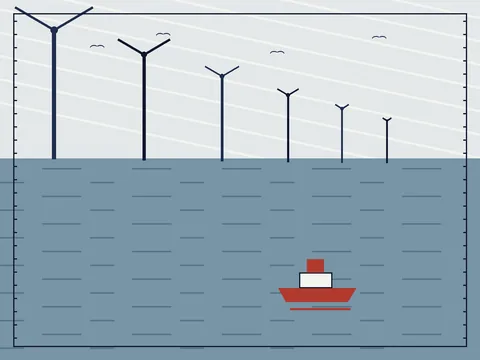
Revolution Wind is, at last report, 65 turbines of roughly 11 megawatts each, for a peak capacity of about 704 megawatts, per the developer's project page. It straddles a state line in a way no earlier American offshore project has: Rhode Island contracted for the balance of roughly 400 megawatts, and the two states share the output of one physical plant. The developer's construction updates describe the project as delivering power since March 2026 and more than 90 percent complete, with completion expected within the year.
Scale needs a reference. Connecticut's grid peaks on the order of seven to eight gigawatts on the coldest winter evenings, per ISO New England, the regional grid operator. Revolution Wind at full output covers roughly a twentieth of that peak. It is not a replacement for the state's largest power station; it is a down payment on a fleet.
The item that failed
Every Connecticut town warrant has one: the article that sounds fine in the budget committee and dies on the floor. The energy version is Park City Wind. In December 2019, the state selected two projects on the same day: Revolution Wind at roughly 704 megawatts, and Park City Wind, a roughly 804 megawatt project from Avangrid that would have landed its export cable in Bridgeport and based its operations there. Together they covered most of the 2,000 megawatts the legislature had authorized for procurement by 2030.
In October 2023, Park City Wind's power purchase contracts were terminated by mutual agreement after the developer said inflation, interest rates, and supply costs had broken the project's economics. The state kept the statutory authorization; it lost the project. Nothing has replaced those 804 megawatts at contract stage, and the statute's 2030 deadline has not moved.
The honest math on your bill
Connecticut's utilities signed the Revolution Wind contracts in 2019 and 2020 at prices the state's selection filings put in the neighborhood of ten cents per kilowatt-hour, indexed over time. Those contracts run roughly two decades. The bet embedded in them was that the locked price would come in under whatever the market charges in the 2020s and 2030s, and the difference would come back to ratepayers.
Some of those years have already vindicated the bet, since New England power prices spiked well above the contract range in 2022. Some future years may not. What you actually see on an Eversource or United Illuminating statement is a small, regulated charge or credit reconciling the contract price against what the supply would have cost, spread across every customer in the state. It is a few dollars a year either way at current prices, not a second mortgage, and anyone who tells you the exact figure for 2031 is guessing.
There is also a second ledger, the one the town meeting cares about: work. New London's State Pier was rebuilt with public money into an offshore wind staging port, and the developer's updates credit the project with hundreds of construction jobs. Whether that infrastructure keeps paying off depends on the empty third of the warrant getting refilled.
Worth watching this week
- Completion notices: the developer's construction updates page is the fastest source for the final turbines and full commissioning; expect them within the year if the current schedule holds.
- The next procurement: DEEP dockets on replenishing the offshore wind authorization under the 2019 statute; the empty 804 megawatts will need a replacement round, and its pricing will tell you where the market thinks this decade's bet sits.
- Capacity auction results: ISO New England's annual forward capacity auction shapes what every generator in the region, including the new turbines, gets paid to stay available.
- State Pier tenants: the Connecticut Port Authority's announcements on New London staging work are a leading indicator of whether the supply chain bet keeps paying.
- Your own bill: the line to watch is the renewable energy charge reconciliation on your supply statement; it is small, and it is yours.
Questions we expect
Short answers, plain languageWill Revolution Wind raise my electric bill?
The contracts were bid in the neighborhood of ten cents per kilowatt-hour in 2019 dollars, per the state's selection filings. Whether that is above or below the market price you pay depends on the year, and the difference passes through as a small line item regulated by the state. The honest answer is that the size and direction of the effect moves with power markets.
Why offshore wind instead of more rooftop solar?
The state is doing both. Rooftop and school arrays add up across hundreds of buildings, but a single offshore project replaces the output of a large power station. The 2019 statute treated them as different tools: distributed projects for local budgets, offshore blocks for supply.
What happened to Park City Wind?
Park City Wind was the roughly 804 megawatt project selected alongside Revolution Wind in December 2019, planned to land its cable in Bridgeport. In October 2023 the developer and the state's utilities ended the power contracts after the developer said the economics no longer worked. The project has no contracts and no path forward without new ones.
When is Revolution Wind fully online?
The developer's construction updates report the project delivering power since March 2026 and more than 90 percent complete. Full completion has been described as expected within 2026, but offshore schedules have slipped before, so treat any date as a plan rather than a promise.
Who buys the power?
Connecticut's electric utilities, Eversource and United Illuminating, hold the purchase contracts on behalf of their customers, which is why the cost shows up on supply lines across the state. Rhode Island holds the rest of the project's output under its own contracts.
Sources of record
Primary documents only- Ørsted, Revolution Wind project and construction updates pages The developer's own record: turbine count, capacity, completion percentage, first-power dates. The numbers we quote for the project itself. revolution-wind.com
- Connecticut DEEP, December 2019 selection announcements The state's procurement record: the paired selections of Revolution Wind and Park City Wind, capacities and contract terms as originally filed. portal.ct.gov
- ISO New England, Connecticut state profile and grid data The grid operator's own figures for state peak demand and resource mix. The reference point for every "how much does this matter" question. iso-ne.com
- Connecticut Port Authority, State Pier project page The public port's own account of the New London pier rebuild and its offshore wind staging role. The public-investment side of the ledger. ctportauthority.com